

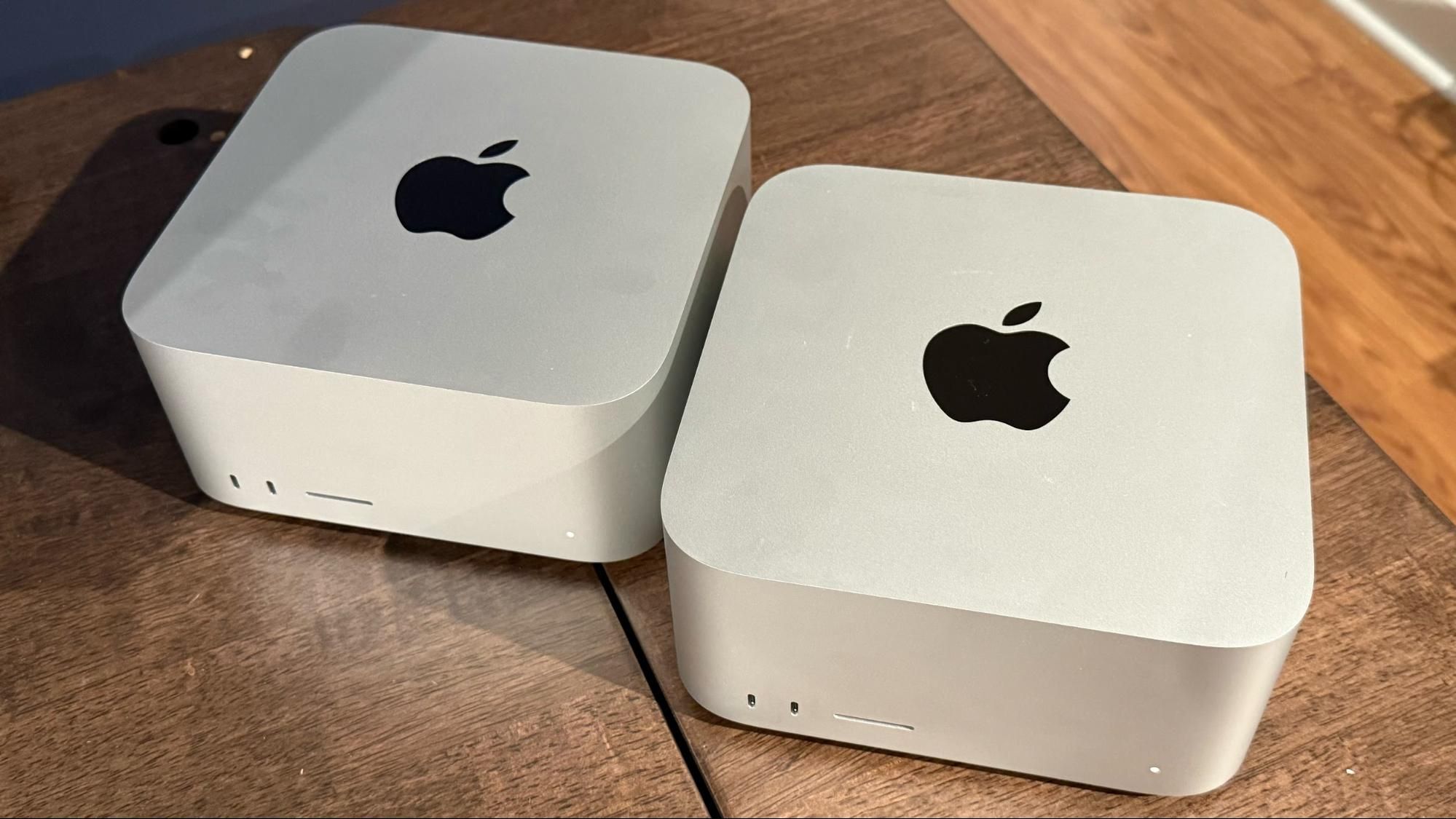
Artificial intelligence is rapidly becoming a core part of personal computing, and Apple’s latest desktop machines reflect that changing landscape. The Mac mini and Mac Studio are designed to do more than deliver conventional desktop performance. Thanks to Apple silicon, unified memory, powerful GPUs, and dedicated Neural Engines, both systems are capable of handling a growing range of AI-related workloads.
What makes Apple’s strategy particularly notable is its focus on AI processing directly on the device. Rather than depending entirely on cloud services, users can perform many AI tasks locally. The Mac mini offers a compact way to explore these capabilities, while the Mac Studio is aimed at professionals and developers who require substantially more memory and processing power.
Mac Mini Offers Serious AI Capability in a Small Package
The latest Mac mini delivers a significant performance boost without giving up its compact design. Built around Apple silicon, it is capable of handling everyday computing while also supporting more demanding artificial intelligence and machine-learning workloads.
The M4 Mac mini features a 16-core Neural Engine, while the M4 Pro model provides higher memory bandwidth and supports configurations with up to 64GB of unified memory.
This architecture is particularly useful for AI applications because the CPU, GPU, and Neural Engine can share the same memory pool. Unlike traditional systems that separate system RAM from graphics memory, Apple’s unified-memory design allows these components to access data more efficiently.
For users, this can improve performance across workloads such as speech transcription, image processing, AI-assisted productivity, and local machine-learning applications.
Apple Intelligence Is Just the Starting Point
Apple has made Apple Intelligence one of the central features of its newest Macs. AI-powered capabilities such as writing tools, summaries, image features, and other productivity functions are designed with an emphasis on privacy and local processing.
But Apple silicon can do much more than run Apple’s own AI features.
Developers can use these Macs to experiment with local language models, speech-to-text systems, image-processing applications, embeddings, and other machine-learning technologies. This makes the Mac mini an attractive option for developers who want to explore AI locally rather than sending every request to a cloud API.
The M4 Pro model is especially interesting for its size, delivering significantly greater memory bandwidth and improved AI performance compared with older Mac mini generations.
Mac Studio Pushes Local AI Performance Further
The Mac Studio sits firmly in the professional desktop category.
It combines Apple’s high-end processors with larger memory options and much greater memory bandwidth. Current configurations include the M4 Max and M3 Ultra, with the M3 Ultra offering up to 80 GPU cores, a 32-core Neural Engine, and memory bandwidth reaching 819GB/s.
These capabilities make the Mac Studio particularly appealing to users working with larger AI models.
Apple has also emphasized the M3 Ultra’s ability to run extremely large language models locally. With enough unified memory, the machine can handle models that would be difficult to run on many conventional consumer computers.
This highlights an important point about local AI: performance depends on more than raw processing power. Memory capacity and bandwidth can be just as important, particularly when working with large language models.
Why Apple’s Unified Memory Is Important for AI
One of Apple’s most significant advantages for local AI workloads is its unified-memory architecture.
On conventional computers with discrete graphics cards, system RAM and GPU VRAM are generally separate. For AI applications, limited GPU memory can become a significant bottleneck.
Apple silicon takes a different approach by allowing the CPU, GPU, and Neural Engine to share a common memory pool.
For developers, this can make it easier to load larger AI models without being constrained by a comparatively small amount of dedicated VRAM.
The higher-end Mac Studio configurations extend this advantage with extremely high memory bandwidth, helping support more demanding AI workloads.
However, more memory alone doesn’t guarantee better performance. Factors such as model architecture, quantization, software optimization, and hardware acceleration can all have a major impact on real-world results.
Local AI Is Becoming an Increasingly Attractive Option
The rising popularity of local large language models is another reason Apple’s desktops are gaining attention among AI enthusiasts and developers.
Instead of sending every prompt to a remote AI platform, users can run compatible models directly on their own computers.
There are several potential advantages to this approach:
- Better privacy: Sensitive data can remain on the user’s computer.
- Reduced API expenses: Local inference can lower reliance on paid cloud services.
- Offline functionality: Certain AI tools can continue working without an internet connection.
- Lower latency: Local processing removes the need to communicate with a remote server for every request.
- More experimentation: Developers can test different open-source models and configurations.
The Mac mini is well suited to smaller models and general experimentation, while the Mac Studio provides the memory and performance needed for more demanding local AI workloads.
AI Development Goes Beyond Chatbots
The AI capabilities of these machines aren’t limited to conversational applications.
Developers can use them to create and test AI-powered software, run local inference servers, process datasets, generate embeddings, experiment with machine-learning frameworks, and build applications that combine local processing with cloud-based services.
A developer might use a Mac mini as a local AI development environment for an application involving language models or speech recognition. Users with more demanding requirements can move to a high-memory Mac Studio to experiment with larger models.
Running these workloads locally can also make development more convenient by reducing the need to send every test request to an external service.
Creative Professionals Can Benefit Too
AI is rapidly becoming part of professional creative software.
Video editors, photographers, musicians, and 3D artists are increasingly using AI-powered tools for transcription, image enhancement, noise removal, object recognition, content creation, and workflow automation.
Apple’s high-performance silicon makes the Mac Studio particularly attractive for heavier creative workloads, while the Mac mini can handle many less demanding AI-assisted applications.
As more creative software integrates machine-learning features, dedicated hardware acceleration is likely to become increasingly important.
Could the Mac Mini Become a Low-Cost AI Workstation?
One of the most interesting aspects of Apple’s strategy is the transformation of the Mac mini.
The Mac mini has traditionally been considered an entry-level desktop, but Apple silicon has significantly changed what the small machine can accomplish.
A compact computer equipped with a modern Apple silicon processor, unified memory, a capable GPU, and a Neural Engine can function as a surprisingly powerful local AI system.
For students, developers, researchers, and hobbyists, this provides an alternative to purchasing or building a large workstation.
Its small size also makes it suitable for systems that need to remain operational for extended periods. Depending on the software setup, a Mac mini could serve as a development server, AI experimentation system, automation machine, or home server.
Mac Studio Targets Demanding AI Workloads
The Mac Studio is designed for users who need significantly more computing resources.
Its higher memory capacities and impressive memory bandwidth give it an advantage when handling large models and computationally intensive applications.
The M3 Ultra configuration stands out because Apple has specifically highlighted its ability to run very large language models locally.
For AI researchers, professional developers, and creative specialists, having access to large amounts of memory can be more valuable than simply having a faster CPU.
There is an important caveat, however. Apple silicon isn’t necessarily the ideal platform for every AI workload. NVIDIA GPUs continue to dominate many AI development and research environments because of CUDA and its extensive ecosystem of optimized tools and libraries.
Efficiency Is Another Part of Apple’s AI Strategy
Power efficiency is another area where Apple’s desktop approach stands out.
AI workloads can require significant computational resources, particularly when models are running continuously. Apple’s ability to provide substantial performance in relatively compact systems makes the Mac mini and Mac Studio appealing to people who want local AI capabilities without building a large, power-hungry PC.
The Mac Studio delivers considerably more performance while remaining relatively compact, while the Mac mini brings the same basic philosophy to a smaller and more affordable form factor.
Important Limitations for Buyers
Despite their strengths, Apple’s AI-focused desktops have limitations that buyers should consider.
Software compatibility is one of the biggest factors. NVIDIA’s CUDA platform remains widely used across AI research, development, and commercial applications, which can make traditional GPU workstations a better choice for certain workloads.
Apple’s unified memory is also not upgradeable in the traditional sense. Because memory is integrated into the system architecture, users need to select an appropriate capacity when purchasing their Mac.
This is particularly important for AI applications.
Someone primarily interested in Apple Intelligence and smaller AI models may not need a high-end Mac Studio. Users planning to work with large language models, however, should pay close attention to memory capacity because insufficient memory can become a major constraint.
What Apple’s Desktop Lineup Says About Its AI Strategy
The Mac mini and Mac Studio provide a strong indication of Apple’s broader approach to artificial intelligence.
Apple isn’t treating AI purely as a cloud-based technology. Instead, it is building AI acceleration into its processors, operating systems, and software development ecosystem.
The Mac mini demonstrates that capable local AI hardware can fit inside an extremely small desktop. The Mac Studio shows that Apple’s architecture can also scale to much larger professional workloads.
As a result, the two machines cover a wide range of AI applications.
Everyday users can benefit from Apple Intelligence and AI-assisted productivity. Developers can use the hardware for local experimentation and application development. Professionals can configure a Mac Studio with enough memory and processing power to work with much larger AI models.
Final Thoughts
Apple’s new Mac mini and Mac Studio are clearly designed with the growing importance of AI in mind.
The Mac mini combines Apple silicon, unified memory, and dedicated AI acceleration in a compact form factor, making it an appealing choice for developers, students, and enthusiasts interested in local AI.
The Mac Studio takes that approach to a much higher level, providing significantly more memory, GPU performance, and memory bandwidth for professional AI and creative workloads.
More importantly, these machines reflect a broader change in computing. Artificial intelligence is gradually moving beyond massive cloud data centers and becoming a capability that can increasingly run directly on personal computers.
Apple’s latest desktops show how local AI can give users greater control over their data while reducing dependence on cloud services.
For those interested in exploring local AI without building a traditional workstation, the Mac mini offers an impressive entry point. For professionals working with larger models and more demanding applications, the Mac Studio provides a far more powerful solution.
